
Are we still underestimating AI's power needs?

Everyone who knows me is aware that I’ve been a broken record saying ‘load growth is going to break things’ and create a breadth of risks & opportunities related to power scarcity. It would be fair to say that the impacts of power scarcity – particularly at a distribution grid level – are an obsession of mine and a driving force behind Keyframe’s existence.
Entering 2026, with the ramp of hyperscale CapEx for AI, the supply demand imbalance underpinning that scarcity is more intense than ever.
While there is substantial uncertainty about how long that will last and what its lasting impact will be, it’s become a consensus view that data center driven load growth will strain the grid and drive-up power prices. Many people ask – ‘are we in a bubble?’

I wanted to confront the opposite question: what if the market is dramatically under-estimating the power need from AI?
On a recent long drive home from a family vacation, I listened to Dwarkesh Patel pepper Elon Musk for 3 hours (okay, I only made it about 2 hours) about building data centers in space. For the uninitiated, Dwarkesh has been called both “Silicon Valley’s favorite podcaster” by the Economist and “to the Doomer crowd what ‘The Ezra Klein Show’ is to Park Slope Liberals” by the New Yorker.
Like a number of outspoken people, I view Elon as someone whose forecasts should be taken ‘seriously, but not literally’. Thirty-nine seconds in… Dwarkesh: What's the reason to put data centers in space? Elon: Well, the availability of energy is the issue.
Elon goes on to list some of the physical and process challenges associated with massively increasing our grid capacity. For example, the permitting and interconnection system would need to be fundamentally restructured, not just tweaked. The current 8-year queue exists because NEPA reviews, state siting approvals, and FERC interconnection studies are sequential, not parallel, and any project can be challenged in court at multiple stages. Getting to 100+ GW/yr requires compressing that to 2–3 years maximum.
Beyond that, significant manufacturing and supply chain constraints exist. Skilled labor. It's a reasonably long list of things in the way.
So you have to ask the question-- might we simply fail to conventionally meet demand, even giving it everything we’ve got?
Major forecasters like BNEF and the IEA have been projecting meaningful data center load growth — but throughout 2025, they have framed it as one of several demand drivers, alongside EVs and air conditioning.
Significant, yes. But manageable.

The problem is those forecasts are aging fast, in an industry that relies on decades long planning cycles to ensure that they can properly plan out generation, transmission, and distribution in a reliable way that does not cause consumer cost increases to outpace inflation (see above, currently not doing so great at that).
But AI is moving too fast for conventional planning. Medium-term demand expectations are changing rapidly and carry a wide cone depending upon what new AI functionality dropped that week. Many industry leaders and analysts project data center needs between 2-20x of where BNEF was projecting less than a year ago… and some projecting that we’ll need to double or triple (or in Elon’s case, septuple – 7x) total US grid capacity.

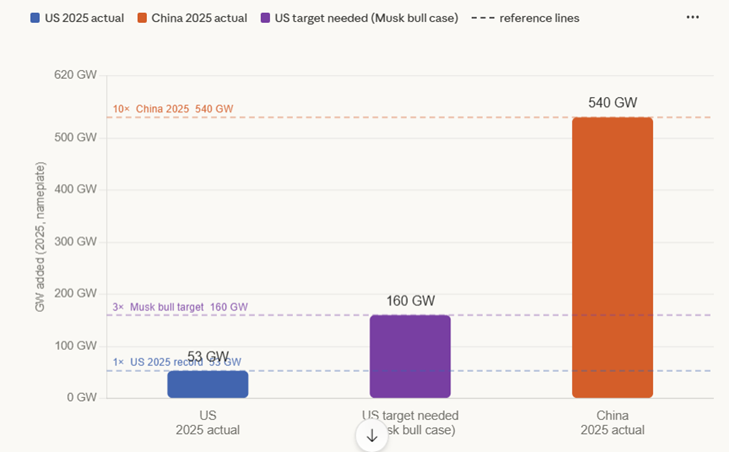
On the high end, these suggest 80-120 (or again Musk separately, 160) GW of added grid capacity per year. Should AI achieve even a small number of scalable use cases and be as productive as 1-2% of today's wages (hopefully by adding productivity to the workforce versus displacing it), you can back into Musk's numbers without making too aggressive of assumptions. But yet... there's just not yet enough medium term certainty for utility companies to efficiently plan out a grid to support that -- so we continue to see conservatism.

It’s popular to look at total capacity additions and say “China does it, we will figure it out.” Claude, please add China to the graph...
But when you double click on China, only ~20% of that 540 GW was firm dispatchable power (coal, gas thermal, hydro, nuclear) – the kind of uninterruptible power needed to power a data center. For comparison, about 4 GW of the US 2025 net additions were firm… so something like a 40x increase on that basis to meet Musk’s expectations.
For skeptics on the scalability of AI’s use cases (of which arguably we’re still figuring out which use cases will stick and keep scaling) – it’s easy bubble-risk bait to point out the 2026 CapEx plans of Hyperscalers, who only represent a fraction of the market.

For the non-skeptics, it appears as if we’ll need to sprint a marathon, carrying everything we own on our backs.
No sweat… we’ve done it before.
Examples of massive coordination to deliver infrastructure and manufacturing growth do exist – but they are found only in the most extreme of circumstances, generally war-time efforts. For example, production of a number of capital goods increased dramatically in the US (and other combatants) during World War II, such as a > 15X increase in aircraft production 1940 to 1944.

It is important to note though that this occurred in an environment where federal defense spending increased from < 5% of GDP in 1940 to > 40% of GDP in 1943/1944.
Is this what's coming for us? That big of a shift in GDP will have to come with large sacrifices. Are we ready to make those sacrifices?
The likely outcome is somewhere in between. Even in that in between, it feels high probability that demand will outpace supply for firm power through the end of the decade and beyond. The more scalable AI use cases become, the more this will be true, the more we’ll start to see the impacts of scarcity ripple throughout the market. Will we build in space? I don’t know (well, I do have views, just going to have to ask me to hear them). But I do have a pretty good sense that we'll be pushed to get a whole heck of a lot scrappier and creative about how to meet the market need, as incrementally improving our existing approach is miles from sufficient.
In an upcoming post, I’ll share an update on where we're seeing the most creative approaches. If you're interested in an advance view of that... send me a note. I'd love to chat.
---
Sources:
IEA base case — IEA Energy and AI Report, Apr 2025 (parent report page); coverage at Data Center Dynamics
Bain & Co base — Bain press release, Oct 2025
DOE / LBNL low & high — DOE article; World Resources Institute summary
Goldman Sachs — Goldman Sachs redacted report PDF; GS insights article
S&P Global / 451 Research — S&P Global, Oct 2025; S&P Global, Nov 2025
BCG high — WRI article citing BCG figure
Dario Amodei — Fortune interview, Feb 2026; Data Center Dynamics write-up; NBC on Anthropic infra commitment
Elon Musk / xAI — Tom's Hardware on Colossus 2 power; Tom's Hardware on 2 GW expansion; SemiAnalysis on Colossus 2


Comments